
Content
Capital allocation at Bitcoin Treasury is guided by a single objective: increasing Bitcoin per Share (BPS)1. Ideally, this involves stacking more Bitcoin. However, there are periods when the most accretive decision is to repurchase our own shares, particularly when they trade at a meaningful discount to the value of the Bitcoin on our balance sheet.
During January 2026, the Company repurchased 47,200 shares at an average price of $5.79, deploying approximately $273k of capital. These purchases were funded through the sale of 2.32 BTC at an average market price of roughly US$87k.
While we are selling Bitcoin below our acquisition cost of approximately US$107k, we are creating accretive value to shareholders by buying back stack at a discount to Net Asset Value (NAV).
Looking Through the Accounting – Focus on Economic Value
The key insight is that capital allocation decisions should be evaluated using current market prices, not historical cost basis.
Bitcoin is a liquid, globally priced asset. Whether the Company originally purchased Bitcoin at US$50k, US$87k, or US$107k does not change its present economic value. When we sold Bitcoin in January, we did so at the prevailing market price, effectively converting one fairly valued asset (BTC) into another opportunity trading below fair value (our shares).
Indirectly Buying Bitcoin at a Discount
At the time of Bitcoin sales and share repurchases in January:
- Implied BPS value of around $7.52 per share2
- Shares were repurchased at an average of $5.79
- Representing an approximate 23% discount to Bitcoin holdings value3
By selling Bitcoin at market and retiring shares at a ~23% discount to BPS, the Company is effectively acquiring additional Bitcoin exposure at roughly US$67k per BTC equivalent – despite the spot price trading near US$87k at the time of our BTC sales.
In other words, selling Bitcoin at market to repurchase deeply discounted shares increases the amount of Bitcoin backing each remaining share.
This is what drives BPS accretion.
Why Cost Basis Is the Wrong Anchor
Cost basis is an accounting measure, not an indicator of future shareholder value.
If the Company refused to sell any Bitcoin below its historical purchase price, it would implicitly allow market volatility to dictate capital allocation decisions. Instead, we remain disciplined and opportunity driven.
When our shares trade at a steep discount to net asset value:
- Repurchases concentrate Bitcoin ownership among remaining shareholders
- Each dollar deployed acquires more Bitcoin exposure than buying BTC outright
- Long-term Bitcoin optionality per share increases
This approach mirrors the capital allocation frameworks used by some of the most successful asset-heavy companies globally: allocating capital where it acquires the most intrinsic value per share.
Our North Star: Bitcoin per Share Growth
Short-term price movements, whether in Bitcoin or our equity, do not alter our strategy.
What matters is the ratio.
If one Bitcoin can retire more than one Bitcoin’s worth of shares based on their implied BPS value, the transaction is accretive.
January’s activity demonstrates this principle in practice:
- Bitcoin sold at market value
- Shares repurchased at a discount to BPS
- BPS increased
A Disciplined, Opportunistic Framework
Share repurchases are not intended to replace Bitcoin accumulation. Rather, they are one tool within a broader capital allocation strategy designed to maximize long-term Bitcoin ownership per share.
We will continue to evaluate opportunities dynamically:
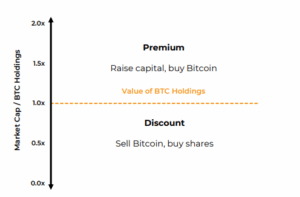
- When shares trade near or above intrinsic value, acquiring Bitcoin directly may be optimal.
- When shares trade at significant discounts, repurchases can deliver superior BPS growth.
Both paths serve the same objective. In Figure 1 below, we illustrate our Capital Allocation Framework.
Our North Star remains unchanged: increasing Bitcoin per Share through disciplined, accretive capital allocation.
Figure 1. Capital Allocation Framework
[1] Bitcoin per Share (“BPS”) is calculated as BTC Holdings divided by diluted shares outstanding, which include convertible debentures and exclude performance warrants.
[2] Implied BPS value is calculated using the starting Bitcoin per Share and the average Bitcoin sale price in Canadian dollars.
[3] The stated discount to Bitcoin holdings value is calculated as one minus the average share repurchase price divided by the implied Bitcoin per Share value.